Why use a wallbox instead of a regular socket?
Coming home, plugging your car into a household socket and charging right away – that sounds simple, but: a standard 230-volt socket only provides about 2.3 kilowatts of power. With the battery capacity of most modern electric cars, a full charge would take around 14 hours. For some models, it can even take up to 40 hours. That’s far too long to be practical for everyday use.
On top of that, standard sockets aren’t designed for continuous high loads. Overheating or even smoldering fires can occur. Charging your electric car from a socket should therefore only be an emergency solution, never a habit.
A much better choice is a private charging station – a wallbox. The differences between models lie mainly in charging power and ease of use. When choosing a wallbox, it’s important that it matches the vehicle you want to charge. The key factor is the car’s built-in onboard charger, which may be single-phase, two-phase or three-phase.
If your car’s onboard charger only supports single-phase charging, a three-phase wallbox won’t offer any immediate benefit – but it’s a good investment for the future, especially if your next car supports multiple phases. The plug type must also match the wallbox socket. In most cases, a Type 2 plug is used, which fits all public AC charging stations in Europe.
It’s also an advantage if the wallbox has an integrated fault current detection system. In that case, a standard Type A residual current circuit breaker is sufficient for the building installation, which is much more affordable.
Charging with solar power and a smart wallbox
A photovoltaic system on your roof reliably generates renewable energy from sunlight – completely emission-free. With a smart wallbox connected to your smart home system, you can even use surplus solar power to charge your electric car.
This surplus charging setup pays off, too: switching to an electric car can qualify you for grants of up to 6,000 euros, plus additional tax benefits.
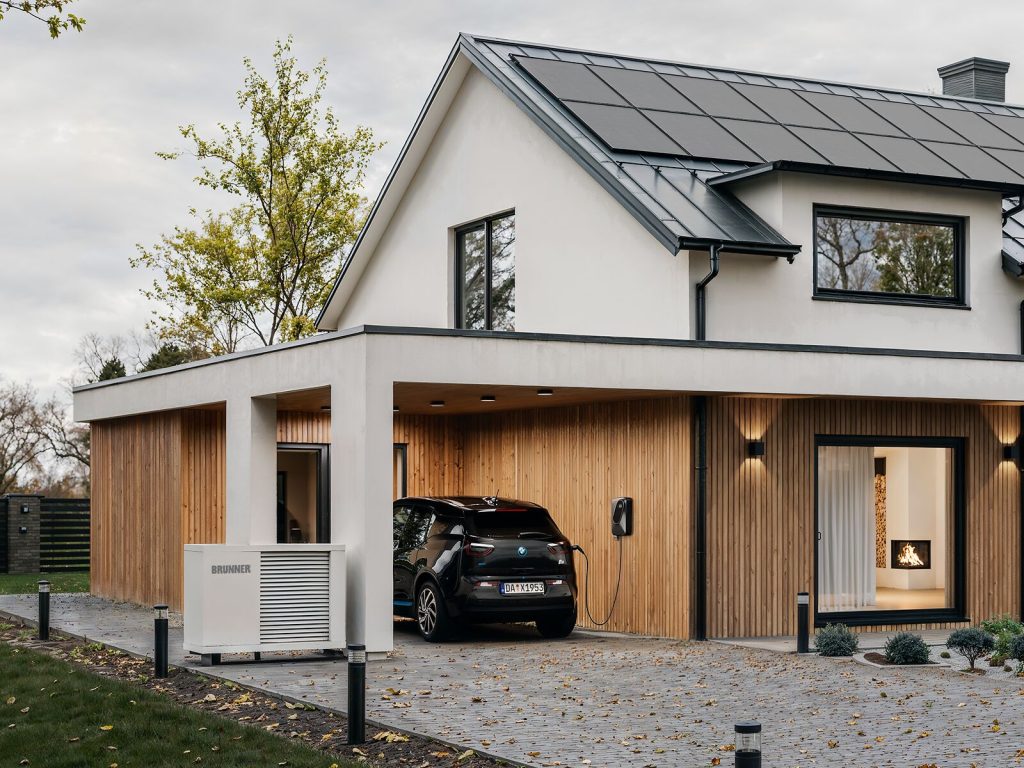
On average, electric cars consume about 20 kilowatt hours per 100 kilometers. If your photovoltaic system produces one kilowatt hour of solar power for around 13 cents, the cost for 100 kilometers is about 2.60 euros. For comparison: at the current electricity price of around 30 cents per kilowatt hour, driving 100 kilometers in an electric car costs about 6 euros, while a petrol car costs at least 9 euros for the same distance.
With a power storage unit and a smart wallbox, you can use the electricity produced during the day later at night by charging your car in the garage with unused solar power. Of course, this also works during the day as long as there is enough surplus energy in the storage unit. A smart wallbox can monitor how much energy the photovoltaic system generates and how much is being used. The charging process starts automatically once the storage is full. If power is suddenly needed elsewhere, for example for the washing machine or dryer, the wallbox pauses charging and resumes when enough capacity is available again.

Why buy a wallbox?
A wallbox is connected to a 400-volt three-phase power supply, just like an electric stove, allowing the car to charge on three phases. With a current of 16 amperes, a home charging station delivers 11 kilowatts of power. A higher-rated wallbox with 32 amperes can reach up to 22 kilowatts. The main advantage of a wallbox is obvious – it significantly shortens the charging time of an electric car. In most cases, charging then takes only between one and four hours.
Public charging stations with direct current (DC) – also known as fast charging stations – can double the possible charging power to around 50 kilowatts. However, only a few vehicles can handle the high power required for fast charging.
Some models therefore use a combination – alternating current (AC) at home and direct current (DC) at public charging stations. The key factor for charging speed is the battery capacity, measured in kilowatt hours. The higher the capacity and charging speed, the greater the driving range of the electric car – but the heavier the battery becomes as well.
Anyone who drives long distances with an electric car can complement the standard charging cable with a mobile wallbox. Even though the public charging network in Germany is expanding rapidly, there may still be destinations without an accessible charging station. A mobile wallbox is available with 16 or 32 amperes and offers charging power of up to 11 or 22 kilowatts.
Expert advice
The power grid in Germany isn’t designed for high loads everywhere, and that also affects the charging capacity of a wallbox. Since 2019, wallboxes must therefore be registered with the local grid operator, and any unit with a charging capacity above 12 kilowatts requires approval. Many regional utility companies also offer their own wallboxes and can help if three-phase power isn’t available where you need it – usually in the garage – by installing a new connection. The installation of a wallbox should always be carried out by a qualified electrician, ensuring that the setup is safe and straightforward.

How much does a wallbox cost?
Basic wallboxes are available from around 500 euros. More expensive models offer extra features, such as monitoring the charging status or automatically resuming charging after an interruption. They can also integrate an existing charging cable and allow configuration options.
A higher-end wallbox can identify the vehicle automatically, making charging as easy as taking a parking ticket. A smart wallbox goes even further – it can charge two electric cars at the same time, and the load management system can be controlled via an app.
Whether charging is cheap or expensive depends on the electricity price. Standard household electricity costs around 30 cents per kilowatt hour, but there are also special tariffs for home charging. It’s worth asking your local energy provider or grid operator about available funding programs and e-mobility tariffs.

Wallbox funding
Public charging stations have been subsidized by the federal government for some time under the Charging Station Ordinance. Since 2020, private charging stations – that is, wallboxes with a single charging point – have also become eligible for government funding. The basis for this is the “Masterplan Ladeinfrastruktur,” which provides a budget of 50 million euros. In addition, a law now grants tenants and homeowners the right to install a wallbox. Since then, the purchase of a private charging station has been subsidized with 900 euros per wallbox. The funding can be applied for through the KfW bank.
These conditions must be met:
- If the wallbox and installation together cost less than 900 euros, no funding is granted.
- The wallbox must have a standard charging capacity of 11 kilowatts.
- The electricity used must come 100 percent from renewable sources.
- The wallbox must be smart and capable of being controlled with grid-supporting functionality.
Conclusion
An electric charging station is always a good idea if you own an electric vehicle and generate surplus power yourself. The costs are manageable, and the excess electricity doesn’t need to be fed back into the grid.