A smart heating system – supporting your heating with hot water
Fireplaces and stoves create comforting warmth. Water-bearing tiled stoves can do even more by transferring part of this heat to the home’s central heating system. This reduces dependence on fossil fuels – and gets you ready for the next winter.

The features
- 1. Safety heat exchanger (overheating protection)
Protects the stove from overheating and ensures maximum operational safety.
- 2. Control lever “cleaning mechanism”
Convenient cleaning for consistently high efficiency.
- 3. Flue outlet “boiler” – side connection
Enables flexible installation options
- 4. Integrated water heat exchanger
Efficiently transfers the generated heat into the heating system.
- 5. Cleaning mechanism
Automatically removes soot deposits and keeps the heat exchanger clean
- 6. Afterburning chamber
Ensures complete combustion and low emissions
- 7. Connection “storage mass” – side
Used for connecting additional storage stones
- 8. Boiler body
Robust construction for optimal heat transfer and long service life
- 9. Primary air inlet
Supplies the combustion chamber precisely with air for a clean and efficient flame.
- 10. Combustion chamber
Made of high-quality chamotte
- 11. Connection points for combustion air duct (external air connection)
Allow controlled supply of external combustion air
The three glass pane options

Water-bearing stove with flat glass panel
The classic wood-burning insert with a boiler jacket. One third of the usable heat output is transferred to the heating system, while the remaining energy from the still-hot flue gases flows into traditional tiled stove heat storage channels. These may include metallic heat exchangers for warm air generation or ceramic flue channels for long-lasting radiant heat.
Thanks to the dimensions of the boiler body and the cast-iron or steel front panel, the B7 and B8 models are ideal for retrofitting existing tiled stoves. This allows an existing radiant stove to be quickly and affordably upgraded to include domestic hot water heating.

Water-bearing stove with curved glass panel
The flue gas-heated heat exchanger surface of this water-bearing system is intentionally smaller than in the parlor boiler design. As a result, the flue gases retain enough energy to heat a small storage mass. This storage mass, responsible for the classic stove effect, can be mounted on top or placed beside the unit. The curved glass panels create a unique sense of depth for the flame display, and depending on customer preference, the stove casing can also be designed in a round shape.
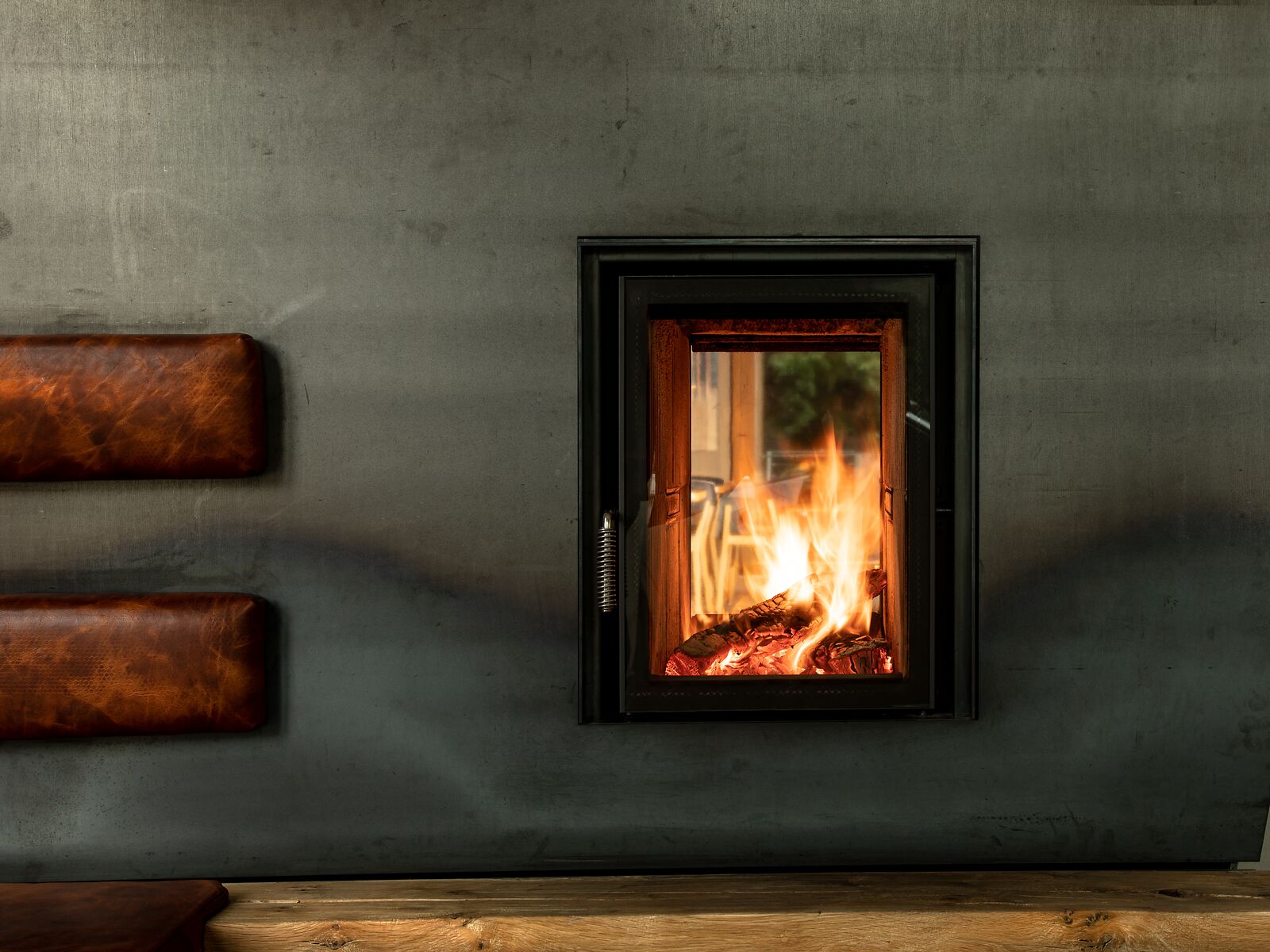
Water-bearing tunnel stove
The continuous, unobstructed view of the fire enhances direct heat radiation during combustion. For frequent use and smaller living spaces, door versions with double glazing are used. The combustion air can be adjusted from both sides, with one door designed as a hinged or tilting door. Visually, the water-bearing tunnel stove is particularly appealing because the beautiful flame pattern can be enjoyed equally from both sides. It also serves perfectly as a room divider.

Primarly Radiant Heat
Water-bearing stoves combine cozy radiant warmth with an intelligent heating solution for the entire building. While the stove provides pleasant heat to the installation room, the integrated water heat exchanger supports the central heating system.
The Different boiler capacities
The water-bearing stove is precisely matched to the home’s heating concept. Depending on requirements, the focus can be placed more on boiler output or on radiant heat. This ensures there is a suitable solution for every home and every heating scenario – from high boiler capacities that support the entire heating system to compact versions designed primarily to create a comfortable warmth in the living area.

High boiler capacity
- with variable boiler output, when the tiled stove is primarily intended to support the building’s heating concept
- Room boiler and additional storage mass

Medium boiler capacity
- with fixed or variable boiler output, for compact stove systems
- Compact boiler and small storage mass

Low boiler capacity
- when the installation room is primarily to be heated by radiant heat
- Compact boiler and large storage mass
The two operating principles of water-bearing stoves

Principle of the room boiler: High boiler output with tiled stove effect
By means of a switching flap in front of the chimney (“Moritz flap”), the heating gases from the combustion chamber can flow either through the water heat exchanger or alternatively through a ceramic storage mass. This “trick” allows the distribution of the heat output to be precisely controlled. If only heating water generation and a compact stove unit are desired, “room boilers” with cleaning mechanisms are connected directly to the chimney. Immediate heat release into the room occurs through the viewing glass, while the stored heat is emitted as pleasant radiant warmth through the stove body once combustion has ended.

Principle of the compact boiler: Tiled stove with boiler component
Heating insert, boiler body, and ceramic storage mass combined on a minimal footprint. We have deliberately omitted external flue gas flaps and large additional heat exchanger surfaces as used in the “room boiler” principle. The compact boiler design allows for space-saving stove configurations — ideal when an old boiler needs to be replaced.
Our water-bearing stoves
Glass pane format


FAQ Water-bearing stoves
- What is the difference between a water-bearing system stove and a water-bearing system fireplace?
Water-bearing system fireplaces feature large viewing windows and emit plenty of radiant heat directly into the room. They heat up quickly and create a strong fire atmosphere – ideal for larger living spaces or new builds, where excess heat is transferred to the heating system.
Water-bearing system stoves, on the other hand, focus on heating water generation. Up to 70% of the heat is transferred into the heating system – perfect when the stove is intended to actively contribute to heating the building and relieve the central heating system.
- How much heat does a water-bearing stove deliver to the buffer tank?
Depending on the design and operating mode, around 50–70% of the generated energy is transferred into the water. The rest is released as radiant heat through the glass front and stove cladding. This targeted distribution makes operation particularly efficient, as surplus energy is not wasted.
- What are the advantages of water-bearing stoves?
Efficiency increase: By diverting heat to water heating, more than 50% of the generated energy can be fed directly into the heating system – particularly useful in low-energy houses.
Lower heating costs & CO₂ savings: Wood as a renewable resource reduces the use of fossil fuels and lowers heating costs.
Hybrid operation possible: In combination with a heat pump and buffer tank, the system can relieve the main heating during transition periods and even serve as the primary heat source in an emergency. - How does a water-bearing stove work?
In a water-bearing stove, the firebox has a double wall. The space in between contains a water jacket or heat exchanger. Excess heat from the flue gases is used to heat water for the heating system. This heated water is stored in a buffer tank and can support both space heating and domestic hot water.
BRUNNER craftsmen search
If you are interested in a BRUNNER stove or heating system, please contact one of our craftsmen.