Take the BRUNNER heat pump green, for example. The summer of 2022 broke all previous heat records, and experts agree that global warming will become increasingly noticeable. While we long for cozy indoor warmth in winter, the desire for air conditioning grows just as strong during hot temperatures. However, air conditioners consume a great deal of electricity and are not exactly environmentally friendly.
As an alternative, a heat pump that can do both – heating and cooling – offers an energy-efficient and eco-friendly solution for keeping rooms and buildings comfortable all year round.
How does a heat pump cool?
A heat pump uses the regenerative solar energy stored in the air for heating purposes. It operates efficiently and without emissions. On average, one kilowatt of electricity is enough to generate three to five times that amount of heating energy. When a heat pump is used for cooling in summer, its original operating principle – the heating cycle – is essentially reversed.
Instead of extracting thermal energy from the heat source (outdoor air, groundwater, or the ground) and transferring it into the heating system, the heat from the heating system is directed back into the heat source. The effect is that radiators or underfloor heating systems become cooler. In this context, a distinction is made between “active” and “passive” cooling in buildings.
To use a heat pump for cooling, the building must have a water-based heating system. However, traditional radiators are not suitable, as their limited surface area cannot effectively transfer cool air. Underfloor heating, wall heating systems, or fan coil units are much better suited for this purpose.

With fan coil units, the greatest cooling effect can be achieved, although it is important to ensure that they are designed for higher cold-water and lower hot-water temperatures. When actively cooling with a heat pump, all pipes must be insulated to prevent condensation or “sweating.”
Active vs. passive cooling
Active cooling mainly refers to air-to-water heat pumps. The compressor continues to run, but the circulation of the refrigerant is reversed. Warm indoor air is extracted and released to the outside environment. A four-way valve ensures that heating and cooling functions operate independently of each other. During the cooling process, domestic hot water can still be heated.
Passive cooling with a brine-to-water or ground or groundwater heat pump bypasses the compressor. Instead, the low temperatures in the ground or groundwater are used to absorb heat from indoor spaces via a heat exchanger. The heat pump itself does not operate actively; only the control system and circulation pump run. The costs are lower than with active cooling. However, passive cooling produces a slower and less intense cooling effect. Passive cooling cannot be achieved with an air-source heat pump because the outdoor air in summer is too warm.
How much can a heat pump cool?
Although heat pumps generally operate more efficiently and with lower power consumption than air conditioners, their cooling effect is somewhat weaker. A passively cooling heat pump can lower indoor temperatures by about three to four degrees. Active cooling can reduce room temperatures more noticeably, but power consumption is significantly higher than with passive cooling. For this reason, combining the system with a photovoltaic installation is recommended.
Another drawback of cooling with heat pumps is the potential for condensation. When temperatures drop below the dew point, moisture can form on the floor or wall surfaces. Therefore, the heat pump control system must constantly monitor the dew point. On the positive side, a heat pump operates quietly. Unlike air conditioners and fans, which can be loud and unpleasant for some people, a heat pump produces neither noise nor drafts.
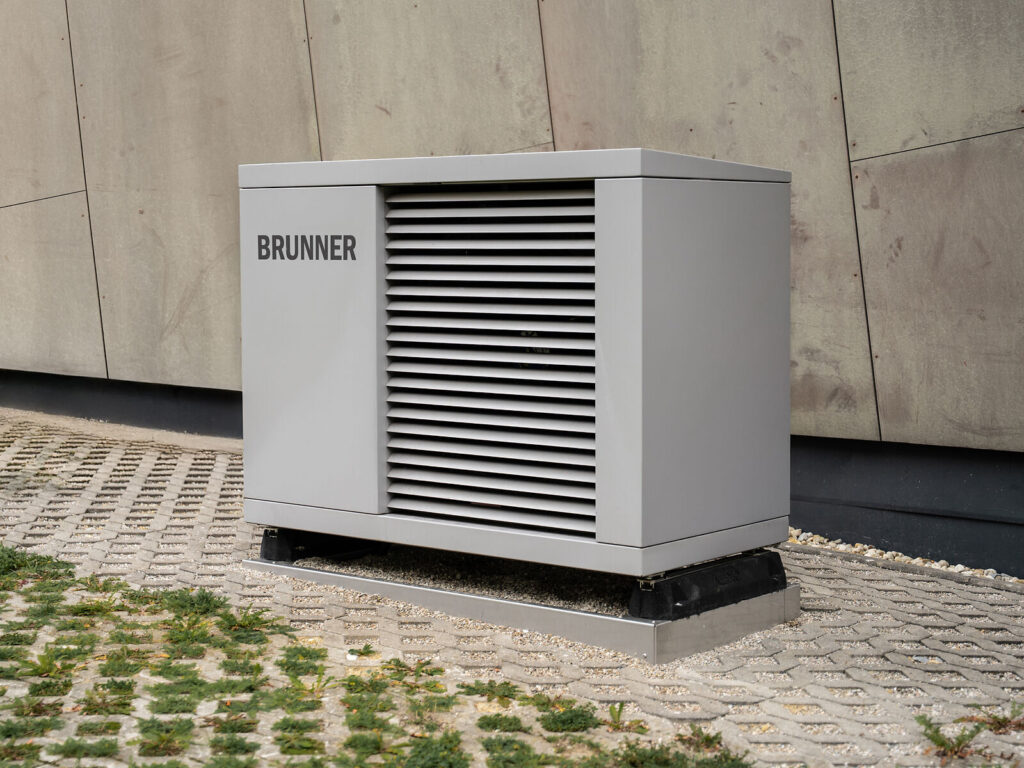
Heat pump with cooling function
Not every unit can automatically cool, but many models can be retrofitted with a heat pump cooling feature, allowing them to be used like an air conditioner. The BRUNNER BWP 9 “green” heat pump also offers cooling capability.
It operates with an environmentally friendly refrigerant, delivers higher performance with lower costs, is more compact and quieter, and can be used both for heating and cooling.
The choice of the right heat pump depends on the available space, the noise level, and the set budget.
Conclusion
A heat pump can be used not only for generating heat but also for cooling. In other words, it serves a dual purpose depending on the season. The cooling effect of a heat pump is especially pleasant – there is no noticeable noise or draft.