Stoves and fireplaces
Fireplace
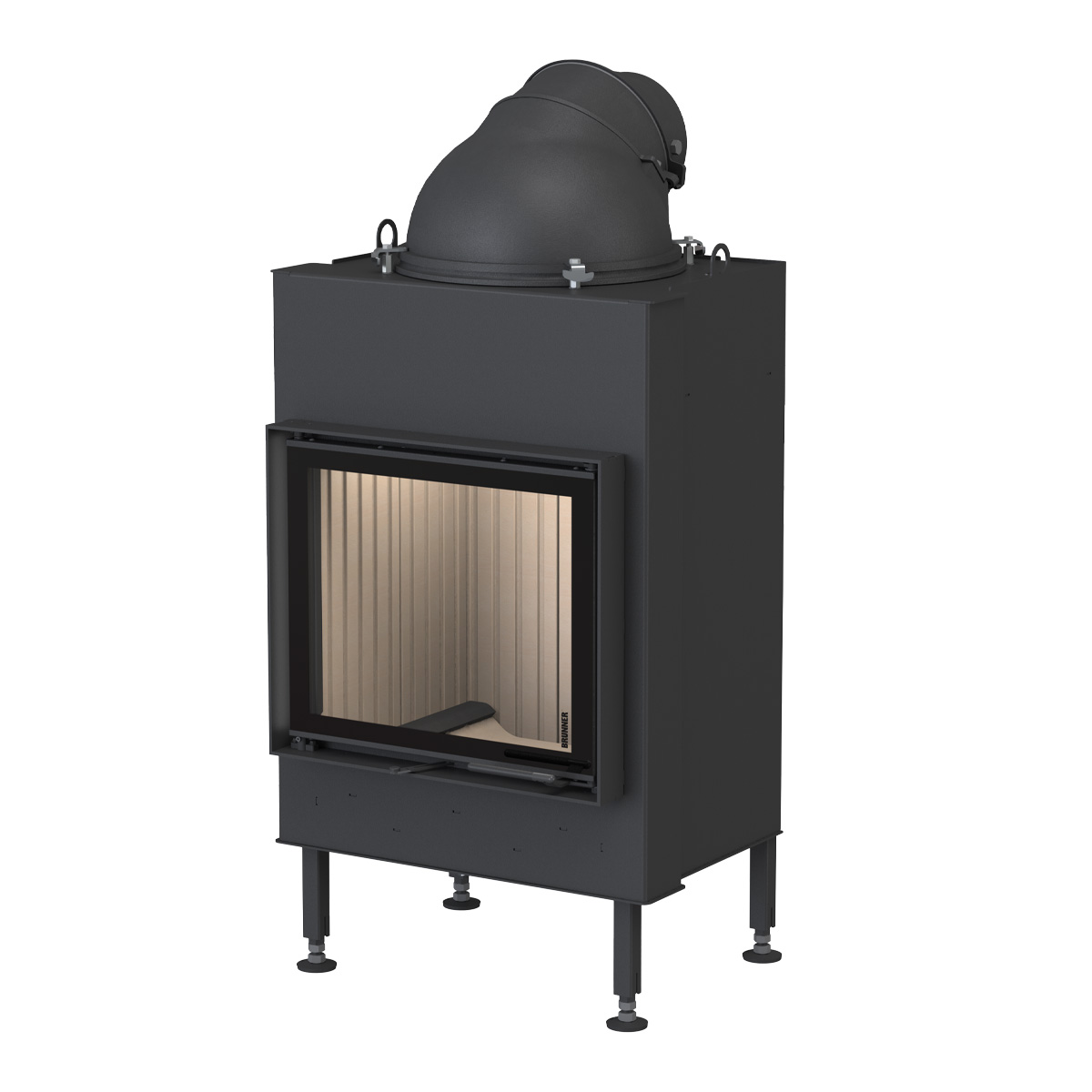
BKH 42-50 Flat
Product benefits:
- Fast and powerful warm air output
- Custom design by skilled craftsmanship
- Patented bowl firing system for especially clean and efficient combustion
- Optionally retrofittable catalytic converter for emission reduction
- Generous view of the fire from one side
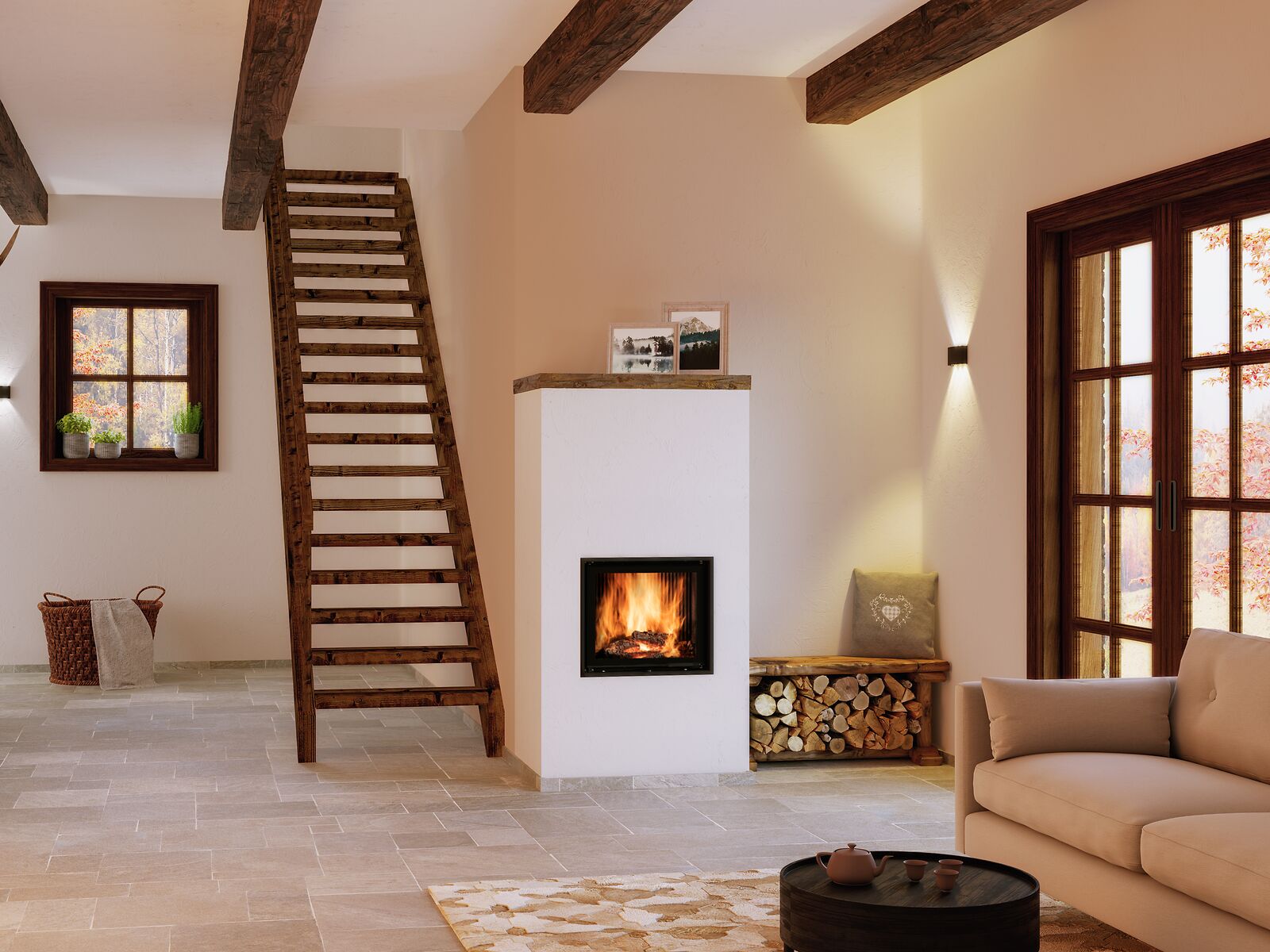
- Ideal for modern living spaces with clean, linear architecture
Main features:


Move your mouse over the icons to obtain more information about the individual main features.
High-quality cast iron components for stability, durability, and premium value
Transfers heat to the heating circuit and supports the central heating system
Releases heat quickly and directly into the room as warm air
Automatically controls the combustion process for efficient and clean heating
Choice of mounting frame or door frame to match any interior style
Keeps the glass pane clean and ensures an optimized combustion process
Simple door mechanism for convenient cleaning of the glass pane
Heat storage and heat release evenly over several hours
Choice of combustion chamber made of durable chamotte or solid cast iron
Optional version for reducing the radiation area
Supplies the stove with combustion air from outside – ideal for modern, airtight buildings
Optional left or right door hinge position – flexible to plan
- Green
- Catalytic converter capable
Technical data
& Downloads

BRUNNER Fireplaces
A fireplace delivers fast, direct warmth through warm air and radiant heat – ideal for anyone who wants a cozy atmosphere right away. With its large glass panes, the fire becomes the centerpiece of the room. The BKH green fireplace series combines modern design with innovative technology: the newly developed bowl firing system ensures an especially beautiful flame pattern, maximum efficiency, and minimal emissions. A catalytic converter can be added as an option, making it a future-proof and eco-friendly way to heat with wood.

FAQ Fireplaces
- Why choose a fireplace instead of a wood stove?
A stove mainly differs in the way it is built. Sold as a finished product, often cheaply available in DIY stores and online shops, it is simply purchased and connected like a consumer good. The heating system cannot be individually adapted to the customer’s living situation or space; individuality comes only from choosing among available models. The motto: set it up, plug it in, light it. Practical – but anything but flexible.
A fireplace, on the other hand, is a custom heating system, designed by an experienced, well-trained craftsman and tailored specifically to your needs. You are not buying a standard product “off the shelf,” but a unique piece of (heat) architecture for your home.
- Is a fireplace right for me?
The variety of wood-burning systems reflects the many different lifestyles and living situations. Not every wood-burner is the same, which is why it’s important to choose a solution that truly fits you. A fireplace is first and foremost about visual appeal. Large glass panes, sometimes used as room dividers or corner designs, offer maximum views of the mesmerizing flames. As a quick-response stove, a fireplace also provides fast heat without the need to warm up storage elements over time. This makes a fireplace especially suitable for those who value the atmosphere of fire, not just the warmth but also the visual experience. It is also ideal for people who spend less time at home, since it delivers quick, comfortable heat for just a few hours in the evening.
- How does the planning of a custom-designed fireplace work?
A high-quality fireplace is not a ready-made product – it is individually planned and built for each customer. To achieve this, stove and heating system builders, often referred to as “Ofensetzer,” complete years of training and master all disciplines of fireplace construction. A premium fireplace must not only fit seamlessly into the interior design and reflect the customer’s personal taste. It also needs to be adapted to the thermal requirements of its surroundings. After all, no one wants a fireplace that overheats the room like a sauna or fails to deliver enough warmth to create comfort on the coldest winter days. Only a qualified craftsman can perfectly combine design, heat architecture, and functionality.
The advantages of individual, handcrafted fireplace construction at a glance:
- Initial consultation for the project
- Optional on-site inspection of the living space
- Tailor-made planning, often including customer-specific adjustments
- Premium construction using high-quality materials and fireplace inserts
- Precise and clean execution
- Customer service and after-sales support
- Extended warranty including service coverage of up to 5 years
- What is the difference between a fireplace and a storage heater?
As the name suggests, a traditional storage heater (such as a tiled stove or a masonry heater) is designed to store heat and release it gradually over time. This is achieved through a very heavy thermal mass, known as ceramic flues, which absorb energy from the hot combustion gases through friction. In many cases, this mass weighs more than a ton. A fireplace, on the other hand, does not have such a thermal mass. Instead, it transfers heat directly into the living space through the glass pane. This has the advantage that the warmth can be felt almost immediately after lighting – unlike a storage heater, which only begins radiating noticeable heat after one to two hours. Another difference lies in construction: since fireplaces lack heavy storage elements, their structural requirements are significantly lower compared to tiled stove or masonry heater. However, the latter offer the benefit of pleasant radiant heat, which keeps the room warm for much longer and even provides health advantages, for example for allergy sufferers.
- What is a fireplace?
A classic fireplace is a wood-burning system designed to provide quick heat and a striking view of the fire. Thanks to its large, expansive glass panes, warmth is released rapidly and directly into the living space. The heat is transferred mainly through the air, creating a type of heat exchange. Fireplaces have become one of the most popular forms of wood heating, as they suit the lifestyle of many modern households. In most cases, the construction consists of steel, specialized fireplace glass, and – in high-quality combustion chambers – genuine Schamotte.
- Fireplace: Where to place it?
Modern fireplaces are designed above all to please the eye. With their large glass panels, they offer a maximum view of the flames and often serve as stylish room dividers. Corner versions can also be real highlights. However, a fireplace should not only be beautifully placed — there are several important aspects to consider when choosing its location.
- One key factor is maintaining a safe distance from combustible materials. Wooden floors or carpets can be protected with special fireproof bases, such as slate or metal plates. To ensure full protection against stray sparks, the covering in front of the fireplace should extend at least 80 centimetres into the room and around 30 centimetres to the sides.
- A proper gap must also be kept between the fireplace and the wall behind it. The required distance depends on the model, but generally ranges between 20 and 60 centimetres.
- Between furniture and the fireplace, there should be at least 120 centimetres of space. If the glass panel has a heat-reflective coating, this distance can be reduced to a minimum of 80 centimetres.
- Depending on the model, a fireplace can be quite heavy. It is therefore essential that the floor can support the weight and meets all necessary structural and fire-safety requirements.
- The appropriate fireplace size depends not only on its location but also on the chimney’s exhaust capacity, which plays a crucial role. To ensure proper smoke extraction, it is advisable to consult a chimney sweep before purchasing. They can inspect the space, assess safety aspects and identify any potential risks.
- Room-air dependent or room-air independent?
For a fire to burn, it needs not only wood as fuel but also oxygen. A fireplace can obtain this either from the installation room or through a separate connection. This is why we distinguish between room-air dependent and room-air independent fireplaces.
With a room-air dependent appliance, the oxygen supply can be regulated using various control levers on the unit. For optimal combustion, the air supply should not be reduced too early, otherwise the wood will not burn properly. In addition, there must always be enough oxygen in the installation room, which means regular ventilation is necessary. Otherwise, there is a risk of dangerous negative pressure. When handled correctly, however, a room-air dependent fireplace is not a problem.
With a room-air independent fireplace or stove, shock ventilation is not necessary because these appliances do not use room air. Instead, they receive their air supply through a dedicated air duct or an external air connection. In new buildings, these air ducts should be included in the planning from the start. For passive and low-energy houses, they are even required by law.
- Which fireplace is right for me?
Nothing creates more atmosphere than the cozy warmth of a real fire: BRUNNER fireplaces are the ideal solution for anyone who wants not only to feel but also to experience wood fire.
Heating fireplaces are installed when the main goal is atmosphere. Their design, fuel capacity and heat output are tailored to this purpose. BRUNNER steel fireplace inserts are available in many different glass formats, with hinged doors or lift-up doors, and with optional heat recovery surfaces – for the perfect atmospheric fire with the desired heating effect.
At first glance, firebox dimensions and glass formats may look similar. Only on closer inspection, and at the latest during operation, do price- or function-optimized product designs from other manufacturers become apparent. BRUNNER focuses on function and quality – uncompromising down to the last detail. BRUNNER steel fireplace inserts are available in many different glass formats, with hinged doors or lift-up doors, and with variable heat recovery surfaces.
Brunner Craftsmen search
Are you interested in a stove or heating system from BRUNNER? Please contact one of our craftsmen partners.